

In the rapidly evolving landscape of mobile machine learning, the efficiency of the runtime environment is just as critical as the accuracy of the neural network models themselves. TensorFlow Lite (TFLite) has long been the gold standard for on-device inference, celebrated for its lightweight architecture and speed. However, as models grow in complexity and edge devices are tasked with more demanding pipelines, even the smallest inefficiencies in the runtime can ripple into significant performance bottlenecks.
In a recent technical deep dive, Alan Kelly, a software engineer at Google, unveiled a series of critical performance optimizations implemented in the TFLite memory arena. By leveraging the power of Simpleperf and pprof, the engineering team managed to drastically reduce overhead, ensuring that developers spend their compute budget on actual inference rather than memory management.
The Core Challenge: Memory Arena Overhead
To understand the scope of these improvements, one must first revisit the fundamental architecture of TFLite. As discussed in previous documentation regarding "Optimizing TensorFlow Lite Runtime Memory," TFLite utilizes a "memory arena"—a sophisticated system that minimizes memory footprints by sharing buffers between tensors. This mechanism allows high-performing models to run on resource-constrained edge devices that would otherwise lack the RAM to execute them.

However, there is a trade-off. While the arena saves memory, it introduces initialization and management overhead. In models characterized by dynamic input sizes and frequent re-allocations, this overhead can become a hidden tax on the device’s CPU. When a model’s output size remains unknown until the moment of operator evaluation, the memory arena must work overtime to track, allocate, and release buffer space, often at the cost of overall pipeline speed.
Chronology of Optimization: A Debugging Journey
The journey to a more efficient TFLite runtime was not a result of guesswork but a rigorous, data-driven investigation. The team focused on a worst-case scenario: a model with highly dynamic tensor requirements, which serves as a stress test for the memory allocator.
Phase 1: Identifying the Bottleneck
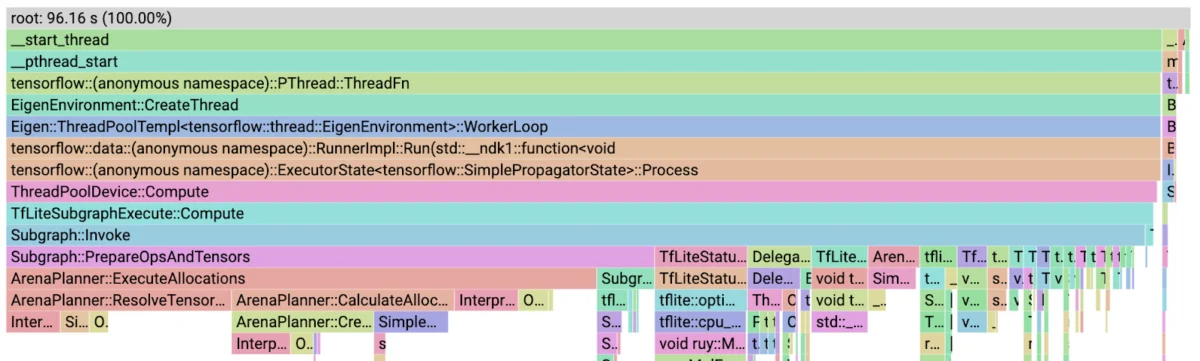
Using Simpleperf, the team performed a profile on the target Android device. The results were startling. The ArenaPlanner::ExecuteAllocations function—the engine behind memory management—accounted for a staggering 54.3% of the total runtime. For an inference engine, this was an unacceptable expenditure of cycles.

The investigation revealed that common culprits, such as complex convolutions or fully connected layers, were not the primary bottlenecks. Instead, the runtime was bogged down by seemingly innocuous tasks. For instance, InterpreterInfo::num_tensors() was consuming 10.4% of the runtime. The culprit was a virtual function call buried inside a loop—a classic example of how high-level architectural choices can have profound impacts at the machine code level.
Phase 2: Early Wins and Architectural Refinement
The initial fixes were deceptively simple. By caching the return value of num_tensors() outside of the loop, the team eliminated redundant calls. Similarly, optimizing access to the tensor array by replacing indirect virtual function lookups with direct pointer arithmetic provided an immediate performance boost. These two minor code refactors alone reduced the model’s overall runtime by 25% and slashed the memory allocator’s overhead by half.
Phase 3: Algorithmic Overhauls
With the low-hanging fruit harvested, the team moved to the more complex task of managing the "Greedy by Size" allocation algorithm. The original implementation struggled with ArenaPlanner::CreateTensorAllocationVector. Because the graph structure is static, the team realized they could store a map of tensors allocated at each node, rather than performing an exhaustive check at every step. This optimization dropped the cost of this function from 4.8% to a mere 0.8%.

Further, the team addressed ArenaPlanner::ResolveTensorAllocation. By introducing a tracking mechanism that only updates pointers when they actually change, they effectively removed this function from the performance profile entirely.
Phase 4: Refining Deallocation
The final major hurdle was the SimpleMemoryArena::Deallocate function. The team initially considered replacing the underlying vector with an std::multimap to improve search efficiency. However, the data revealed a counterintuitive truth: while std::multimap offers superior asymptotic complexity (O(log N)), the constant overhead and poor cache locality compared to a simple vector actually made the performance worse.
Instead of changing the data structure, the team improved the strategy. By implementing SimpleMemoryArena::DeallocateAfter(int32_t node), they allowed the system to perform a single-pass cleanup of records, converting an O(N²) operation into a clean O(N) process.

Supporting Data: The Impact of Profiling
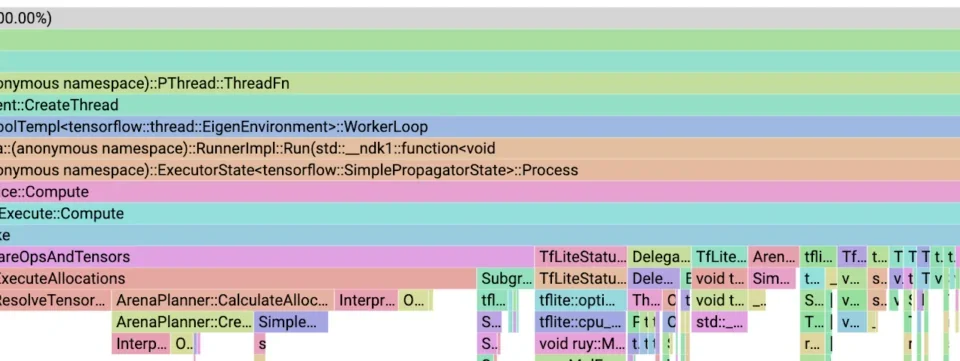
The transformation of the performance profile is best visualized through the lens of flame graphs. Before the optimizations, the runtime was dominated by management overhead, with ArenaPlanner::ExecuteAllocations consuming nearly half of the device’s processing capacity.
Following the sequence of targeted optimizations, the profile shifted dramatically. The overhead of tensor allocation plummeted from 49.9% to roughly 11%. Through a final process of "purging" inactive allocation records during execution—which reduced the "N" in the O(N²) complexity calculation—the team eventually pushed the allocation overhead down to a mere 6%.
Crucially, this meant that the most expensive part of the profile was finally the actual neural network operators (like convolutions). This represents the "gold standard" for inference runtimes: the CPU should be dedicated to the heavy lifting of mathematical tensor operations, not the bookkeeping of memory buffers.

Official Perspective: The Role of Tooling
The success of this project highlights the indispensable nature of modern profiling tools in software engineering. According to the TensorFlow team, the use of Simpleperf and pprof was not just a convenience—it was a necessity. Simpleperf allowed the team to capture accurate, on-device telemetry, while pprof provided the visualization required to identify the specific function calls causing the degradation.
"Simpleperf made identifying these inefficiencies easy," noted Alan Kelly. The team emphasized that these bottlenecks are often invisible to static code analysis. Without profiling the actual binary on the target hardware, developers are often left optimizing the wrong parts of their codebase. The ability to see annotated source code and assembly side-by-side with performance graphs allowed the team to pinpoint, verify, and resolve issues that would have otherwise persisted in production.
Implications for the ML Community
The implications of these changes are far-reaching. The optimized memory arena is now part of the public TensorFlow 2.13 release. For developers building on-device machine learning applications, this means:

- Lower Latency: Models will experience faster startup times and more consistent inference speeds, particularly on devices with limited memory.
- Increased Model Complexity: By reducing the "tax" of memory management, developers can potentially push larger or more complex models to devices that were previously at the edge of their capacity.
- Better Battery Efficiency: By reducing the total number of CPU cycles required for each inference pass, devices will experience reduced power draw, extending the battery life of mobile and IoT hardware.
- Standardized Best Practices: The documentation of this process serves as a roadmap for other engineers. It highlights the importance of caching, minimizing virtual function calls, and favoring cache-friendly data structures (like vectors) over more complex alternatives (like multimaps) when the underlying workload benefits from sequential memory access.
Ultimately, this effort reinforces a core tenet of performance engineering: optimization is an iterative process of measurement and refinement. By focusing on the "invisible" runtime operations, the TensorFlow team has ensured that the next generation of mobile AI remains fast, efficient, and accessible. For those looking to optimize their own TFLite pipelines, the provided instructions on using Simpleperf serve as a clear invitation to begin their own journey into the depths of their application’s performance.
